NEWS
🚨 BREAKING: The Supreme Court is about to reshape presidential power—and this could directly impact Trump’s second term! ⚡ What does this mean for him—and for the country? The legal stakes have never been higher… 👉 Click here to see the full story and what’s at risk

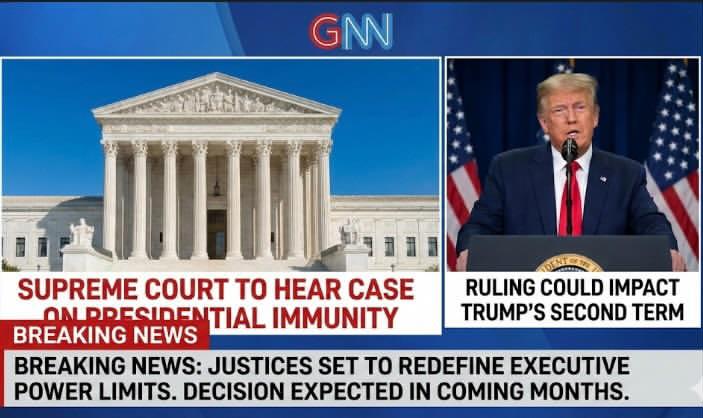
Supreme Court Set to Redefine Presidential Immunity — A Watershed Moment in U.S. Constitutional Law
In a development with profound implications for the balance of power in American democracy, the U.S. Supreme Court is poised to reshape the legal doctrine of presidential immunity, potentially altering the scope of presidential power well into the future. This comes at a time when President Donald Trump’s second term — already full of controversy and political division — is now being framed not just by policy battles, but by a legal redefinition of how far a president can be held accountable under the law. �
What Is Presidential Immunity?
At its core, presidential immunity refers to legal protections that shield a sitting or former president from certain lawsuits or criminal prosecutions based on actions taken in office. Historically, the U.S. legal system has recognized that presidents need some degree of protection to fulfill the duties of the office without constant fear of legal entanglement. But that protection has always been debated, especially when presidential actions are challenged as wrongful or criminal. �
The landmark case in this arena is Trump v. United States, decided by the Supreme Court in 2024. In a 6–3 opinion, the Court ruled that presidents are entitled to absolute immunity for acts within their “core constitutional powers” and at least presumptive immunity for official actions. However, the Court also made clear that there is no immunity for unofficial acts — actions that fall outside the scope of presidential duties. �
Why This Ruling Matters Now
The Supreme Court’s reinterpretation of presidential immunity has become a central issue because it directly affects ongoing and potential legal actions involving President Trump. In several high‑profile cases — including prosecutions and civil suits related to the 2020 election and the January 6 Capitol attack — Trump’s legal team has argued that he should be shielded from prosecution or legal liability based on his presidential status. �
These arguments have already had real legal consequences. For example, a federal appeals court recently cited the Supreme Court’s immunity ruling in reconsidering Trump’s efforts to reverse a New York state hush‑money conviction — signalling that the decision could affect criminal cases beyond federal jurisdiction. �
What the Supreme Court’s Ruling Actually Means
The 2024 decision clarified several key points about presidential immunity:
1. Absolute immunity for “core constitutional powers.”
The Court held that a president cannot be criminally prosecuted for actions that fall within the most fundamental powers of the office, such as national security decisions, diplomatic functions, and other duties explicitly granted by the Constitution. �
Wikipedia
2. Presumptive immunity for official acts.
Actions taken as part of official presidential responsibilities are generally protected unless another court later determines otherwise. In practice, this means some prosecutorial efforts may be delayed or blocked while courts sort out whether the acts in question truly qualify. �
Wikipedia
3. No immunity for unofficial acts.
Criminal conduct or civil liability falling outside official duties — like personal activities or actions not directly tied to constitutional authority — theoretically remains prosecutable. The difficulty, however, lies in determining which actions are “official” and which are not — a question that continues to fuel legal battles. �
PolitiFact
These distinctions are not mere legal theory; they have practical consequences for how justice is administered. For example, the immunity ruling could delay Trump’s trials related to election‑interference charges, because lower courts must now painstakingly classify individual allegations as official or unofficial acts. �
PolitiFact
Political and Constitutional Implications
The Supreme Court’s redefinition of immunity strikes at the heart of the separation of powers, a constitutional principle that divides authority among the executive, legislative, and judicial branches. Critics argue that broad immunity could insulate presidents from accountability, effectively elevating them above the law. Supporters, by contrast, say it protects the presidency from politically motivated litigation that could distract or cripple a sitting leader. �
Northeastern Global News
Indeed, some legal scholars warn that the doctrine could be interpreted expansively in future cases, potentially giving future presidents a “blank check” to act without fear of legal consequences — as long as their actions are framed within official duties. �
Northeastern Global News
Conversely, opponents of the Court’s approach have pushed back both legally and politically. Democrats in Congress have introduced proposed legislation like the “No Kings Act,” aimed at limiting presidential immunity and reaffirming that no individual should be above the law — echoing foundational American principles. �
The Guardian
What’s Next
The legal battles around presidential immunity are far from over. Lower courts must interpret and apply the Supreme Court’s framework to real‑world cases — a process that will likely generate more appeals back to the high court and shape legal precedent well beyond this election cycle.
For President Trump, the stakes are enormous. A broad interpretation of immunity could mean dismissals or delays in key prosecutions. A narrower interpretation could open the door for accountability in matters that have long been politically and legally contested.
As the judiciary continues to unpack the meaning and limits of presidential immunity, the ruling stands as a historic milestone — one that will influence how American presidents wield power, and how the rule of law functions at the highest levels of government.