
NFL
🚨 BREAKING: A federal judge just shut down a controversial move linked to Donald Trump — ordering a slavery exhibit restored immediately. The ruling was swift. Direct. Brutal. “Put it back. NOW.” Supporters are outraged. Critics are celebrating. 👉 Click the link to read the full decision and see what really happened.

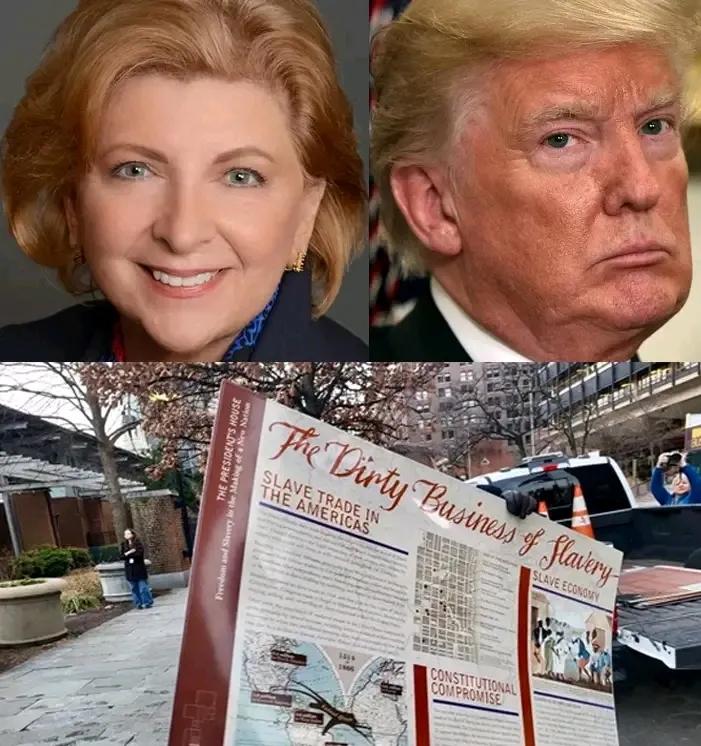
Federal Judge Forces Trump Administration to Restore Slavery Exhibit Removed in Philadelphia
In a sharply worded ruling on Monday, a federal judge in Pennsylvania ordered the Donald Trump administration to reinstall a slavery exhibit at a historic site in Philadelphia after it was removed earlier this year — a case that has touched off fierce debate about how American history is presented on public land.
The exhibit in question was part of the President’s House Site at Independence National Historical Park, where the nation’s first president, George Washington, lived with his household and several people he enslaved during the late 1790s. Installed in 2010 as a joint project of local and federal authorities, the open‑air exhibit featured panels and multimedia detailing the lives of nine enslaved individuals, including figures such as Oney Judge and Hercules, who had sought freedom from enslavement.
Exhibit Removal Triggers Lawsuit
The controversy began in late January, when workers from the National Park Service (NPS) dismantled and removed 34 panels and video displays from the site. The action came in response to an executive order issued by the Trump administration in 2025 aimed at reshaping how federal historic sites portray parts of American history. Critics viewed that order as an effort to curtail narratives about slavery, Indigenous displacement, LGBTQ+ history, and other topics that some officials felt “disparage” the nation’s past. �
Shortly after the removal, the City of Philadelphia filed a federal lawsuit, arguing the federal government had unlawfully taken down the displays without proper authority and that the exhibit was part of a long‑standing agreement between the city and the NPS. Philadelphia sought an injunction to restore the panels and prevent further changes. �
Judge Cynthia Rufe’s Ruling
U.S. District Judge Cynthia M. Rufe, appointed by former President George W. Bush, issued the ruling on Presidents Day, granting Philadelphia’s request for a preliminary injunction and ordering the federal government to “restore the President’s House Site to its physical status as of January 21, 2026” — the day before the panels were dismantled. �
In a striking legal opinion, Judge Rufe began her written order by citing a passage from George Orwell’s dystopian novel 1984, drawing a direct comparison between the novel’s fictional “Ministry of Truth” — which rewrote history to suit the state’s agenda — and what she described as an attempt by the federal government to alter historical truth. “As if the Ministry of Truth in George Orwell’s 1984 now existed … this Court is now asked to determine whether the federal government has the power it claims — to dissemble and disassemble historical truths when it has some domain over historical facts … It does not,” she wrote. �
Judge Rufe also criticized the legal arguments presented by the Department of Justice and the Interior Department, labeling some of the positions taken by government lawyers as “horrifying” and dangerous in their implications for historical integrity and public trust in federal institutions.
Implications of the Ruling
The judge’s order not only requires the immediate restoration of the panels and related materials but also blocks the federal government from making any further alterations to the site, including the installation of new displays or reinterpretations, without written agreement from the City of Philadelphia.
While the order does not specify an exact deadline for the physical reinstallation of the exhibit, it establishes that the site must be returned to its status as of January 21, 2026, while the broader legal case continues. Federal officials can appeal the ruling. �
Inquirer.com
Broader Backlash and Reactions
The decision has drawn strong reactions from across the political spectrum:
Civil rights groups and local officials in Philadelphia hailed the ruling as a victory against efforts to whitewash history and an affirmation of the importance of acknowledging the full scope of America’s past. �
AP News
State lawmakers and community leaders celebrated the court’s stance, saying it protected an important memorial to enslaved people and resisted attempts to sanitize uncomfortable truths. �
Connecticut Post
Administration spokespersons defended the broader effort to review historical content at federal sites and argued that it was intended to ensure a balanced and unified national narrative, describing critics’ claims as misinterpretations of policy goals. �
Yahoo News
Why This Matters
The case highlights an increasingly contentious national debate over how history is presented in public spaces and who holds the authority to shape that narrative. Historic sites, museums, and educational exhibits have long been arenas of political and cultural contention, especially around topics such as slavery, civil rights, and colonial‑era narratives.
By explicitly invoking Orwell’s 1984, Judge Rufe underscored the judiciary’s role in checking government action that could cross from policy preference into censorship or revisionism of historical fact. Her ruling reinforces the idea that historical truth — even when uncomfortable — has legal protections when it comes to public memorials and federally managed sites. �
The Washington Post

BREAKING: Study reveals Trump’s Iran war has cost American households $750 each Trump launched a war in Iran in February without a single vote from Congress, and American families are now footing the bill. A new analysis from Moody’s Analytics puts the total cost to U.S. households at $100 billion so far, working out to roughly $750 per household.
BREAKING: TOTAL DEFEAT! Trump abandons his $1.8 billion slush fund for insurrectionists and MAGA pedophiles after America revolted against the deeply corrupt plan.
BREAKING: A federal appeals court dealt a major blow to the Trump administration’s transgender military policy, ruling that thousands of transgender service members are likely to succeed in their constitutional challenge.
Kennedy Center Fight Sparks Fresh Trump Reactions Political attention remains fixed on Donald J. Trump after a federal judge ordered the removal of Trump’s name from the Kennedy Center and blocked plans to close the institution for major renovations.
🚨👀 THE EPSTEIN FILE SHOWDOWN IS LITERALLY BLOWING UP WASHINGTON! Congressman Thomas Massie has completely rocked the political world by demanding the immediate release of the unredacted Jeffrey Epstein files! Massie went absolutely wild on the DOJ, accusing them of actively shielding insanely powerful names from the public view. Transparency advocates are screaming that the full truth must drop to restore public trust, while critics claim it’s a dangerous media circus. Is a massive cover-up happening right now, or is this just political theater? Do you support a full congressional review to uncover the truth, or it will raise a political warfare?

TUSK CZY NAWROCKI? Nowy sondaż szokuje. Polacy wyraźnie wybrali, komu ufają bardziej
At 8:15 this morning, the President of the United States began panicking in front of the entire world. For more than seven hours, he posted nearly 50 times. And when he finally slowed down, it would stand as one of the most revealing fits of rage of his presidency to date. Because what he shared was beyond any reasonable person’s comprehension.
🚨 JUST IN: 🇺🇸 US forces fire a missile at a ship attempting to bypass the American blockade in the Gulf of Oman
Donald J Trump’s name being torn down from the John F. Kennedy Center for the Performing Arts in Washington, D.C. wasn’t just a slap in the face to the GOP and their bad policies it was a reminder that hate has no place in America. U.S.A.
🚨 JUST IN: 🇵🇱🇷🇺 Polish Foreign Minister Radosław Sikorski says: “Regardless of whether it was on purpose or the result of ineptitude, Russia is still dangerous and we must defend ourselves against it.”
🚨 JUST IN: 🇮🇷🇺🇸 An Iranian missile strike on a U.S. military base in Kuwait reportedly injured five Americans and damaged MQ-9 Reaper
