
NEWS
BREAKING: Béla Fleck, one of the most respected musicians on the planet and an 18-time Grammy winner, just pulled out of THREE Kennedy Center concerts, in protest of Trump’s fascism. 👏 Another hard slap in the face for Donald.

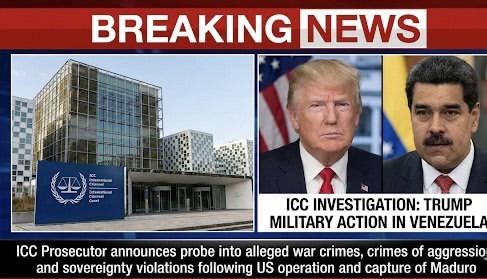
U.S.–Venezuela Military Operation Sparks Global Outcry and Legal Debate – But No Confirmed ICC War Crimes Investigation Yet
On January 3, 2026, the United States launched a surprise military operation inside Venezuela that resulted in the capture of Venezuelan President Nicolás Maduro and his wife, Cilia Flores. Maduro was swiftly transported to New York, where he now faces federal narco-terrorism and drug trafficking charges in a Manhattan court. �
AP News +1
The raid has set off diplomatic shockwaves across the world, igniting fierce debates over sovereignty, international law, and whether the United States’ actions amount to a crime of aggression. While some governments and commentators have called for accountability in forums such as the United Nations, as of now there is no public record of the International Criminal Court (ICC) opening a new probe into the U.S. military action itself.
What Happened in Caracas
According to multiple confirmed reports, U.S. special operations forces conducted a military strike and extraction in Caracas that led to significant casualties among Venezuelan military personnel. Venezuela has since declared a period of national mourning for military officers killed in the raid. �
Reuters
Maduro and Flores appeared in U.S. federal court on January 5, where they pleaded not guilty to charges including narco-terrorism and conspiracy to traffic cocaine to the United States. Maduro maintains that he remains Venezuela’s legitimate president and has described his capture as an unlawful abduction. �
AP News
International Reaction: Sovereignty and Legal Controversy
The U.S. government defends the operation as part of a long-standing criminal indictment and argues it acted in a law-enforcement capacity. But many nations and legal experts dispute this justification. At an emergency session of the United Nations Security Council, countries including Brazil, China, Cuba, Mexico, Russia, and South Africa denounced the strike as a violation of Venezuela’s sovereignty and a “crime of aggression” under international law. �
The Guardian
International law scholars highlight that the UN Charter prohibits the use of force against another state’s territorial integrity or political independence unless in clear self-defense or with Security Council authorization—neither of which have been credibly established in this case. �
The Guardian
The ICC and Venezuela: What’s Already Happening
The International Criminal Court (ICC) is an independent international tribunal tasked with investigating and prosecuting genocide, war crimes, crimes against humanity, and, in limited cases, crimes of aggression. However, its jurisdiction and cases are bound by the Rome Statute, and it generally does not investigate actions by states that are not party to that treaty unless a situation is referred by the UN Security Council.
In previous years, the ICC has opened an investigation into allegations of crimes against humanity related to Venezuela, focusing on human rights abuses dating back to 2014. This work predates the current crisis and is not centered on the U.S. operation. �
ECCHR
Importantly, there is no confirmed report that the ICC has now pivoted to open a fresh investigation into the U.S. military attack on Venezuela or that it has declared U.S. actions a crime of aggression. Such a move, if it were to happen, would require formal steps by the ICC Prosecutor and likely a referral from the Security Council or other procedural trigger—none of which have been publicly documented as of this writing.
Why Some Are Calling for ICC Action
Critics of the U.S. operation argue that the use of force inside a sovereign state without clear UN approval could qualify as a crime of aggression under international law. They point to Article 2(4) of the UN Charter, which prohibits the threat or use of force against the territorial integrity of another state without legitimate grounds. �
World Socialist Web Site
Such arguments have fueled diplomatic pressure and calls—especially from Latin American governments and international human rights advocates—for accountability mechanisms, including at institutions like the ICC. Yet so far, this remains political and legal debate, not an established court proceeding against U.S. officials.
Looking Ahead: Legal Battles and Global Ramifications
Maduro’s legal team is expected to contest not only the charges in U.S. court but also the legality of the operation itself, including claims of unlawful arrest and violation of sovereign immunity. ◆ The unfolding legal battles may raise unprecedented questions about the reach of national prosecution versus international norms of state conduct.
Meanwhile, U.S. allies and adversaries alike are watching closely. The controversy highlights broader tensions over great-power intervention, the enforcement of international law, and the role of global institutions like the ICC in addressing alleged violations of sovereignty and human rights.

BREAKING: Study reveals Trump’s Iran war has cost American households $750 each Trump launched a war in Iran in February without a single vote from Congress, and American families are now footing the bill. A new analysis from Moody’s Analytics puts the total cost to U.S. households at $100 billion so far, working out to roughly $750 per household.
BREAKING: TOTAL DEFEAT! Trump abandons his $1.8 billion slush fund for insurrectionists and MAGA pedophiles after America revolted against the deeply corrupt plan.
BREAKING: A federal appeals court dealt a major blow to the Trump administration’s transgender military policy, ruling that thousands of transgender service members are likely to succeed in their constitutional challenge.
Kennedy Center Fight Sparks Fresh Trump Reactions Political attention remains fixed on Donald J. Trump after a federal judge ordered the removal of Trump’s name from the Kennedy Center and blocked plans to close the institution for major renovations.
🚨👀 THE EPSTEIN FILE SHOWDOWN IS LITERALLY BLOWING UP WASHINGTON! Congressman Thomas Massie has completely rocked the political world by demanding the immediate release of the unredacted Jeffrey Epstein files! Massie went absolutely wild on the DOJ, accusing them of actively shielding insanely powerful names from the public view. Transparency advocates are screaming that the full truth must drop to restore public trust, while critics claim it’s a dangerous media circus. Is a massive cover-up happening right now, or is this just political theater? Do you support a full congressional review to uncover the truth, or it will raise a political warfare?

TUSK CZY NAWROCKI? Nowy sondaż szokuje. Polacy wyraźnie wybrali, komu ufają bardziej
At 8:15 this morning, the President of the United States began panicking in front of the entire world. For more than seven hours, he posted nearly 50 times. And when he finally slowed down, it would stand as one of the most revealing fits of rage of his presidency to date. Because what he shared was beyond any reasonable person’s comprehension.
🚨 JUST IN: 🇺🇸 US forces fire a missile at a ship attempting to bypass the American blockade in the Gulf of Oman
Donald J Trump’s name being torn down from the John F. Kennedy Center for the Performing Arts in Washington, D.C. wasn’t just a slap in the face to the GOP and their bad policies it was a reminder that hate has no place in America. U.S.A.
🚨 JUST IN: 🇵🇱🇷🇺 Polish Foreign Minister Radosław Sikorski says: “Regardless of whether it was on purpose or the result of ineptitude, Russia is still dangerous and we must defend ourselves against it.”
🚨 JUST IN: 🇮🇷🇺🇸 An Iranian missile strike on a U.S. military base in Kuwait reportedly injured five Americans and damaged MQ-9 Reaper
