
NEWS
BREAKING: Five Republican Senators DEFY Trump and break ranks to pass a vote to neuter his military power in a shock betrayal. If Donald Trump believed he could bomb another country, kidnap its president, and claim its oil reserves without pushback from a neutered Congress, he was faced with a rude awakening today as the usually compliant senior chamber of the federal legislature finally awoke from its torpor. On Thursday, the U.S. Senate delivered a rare, bipartisan rebuke to Trump’s out-of-control warmongering, advancing a War Powers resolution to stop him from launching further military attacks on Venezuela without congressional approval. The vote — 52 to 47 — came after Trump ordered a weekend raid on Caracas that spiraled into injuries, civilian deaths, and the shocking seizure of Venezuelan President Nicolás Maduro, all without notifying lawmakers. Trump’s excuse for not even notifying Congress in advance? They have a “tendency to leak.” That flimsy justification didn’t fly — even with Republicans. Led by Democratic Sen. Tim Kaine and joined by Republican senators Rand Paul, Susan Collins, Lisa Murkowski, Todd Young, and Josh Hawley, the resolution makes clear what the Constitution already plainly delineates: one man does not get to start a war. “Bombing another nation’s capital and removing their leader is an act of war, plain and simple,” Kentucky Senator Paul said, bluntly reminding Trump that the presidency is not an imperial throne. Paul positioned his criticism in a way to make it less of a direct attack on Trump by adding, “The reason you argue on principle against even things that appear to be good … isn’t even always for the current president, it’s for the next president,” he said. Senator Kaine of Virginia was even more critical, calling Trump’s actions “clearly illegal,” “deeply unpopular,” and “suspiciously secretive.” While Americans struggle with rising costs, Trump was busy launching a shadow war that experts say has already killed at least 110 people, with disputed claims about drug trafficking used as cover for what Democrats now say looks like a plan for regime change and the purloining of natural resources like Venezuela’s sizable oil reserves. And the threat of unauthorized war doesn’t stop with Venezuela. Trump has openly threatened military action against Iran, Greenland, Cuba, Colombia, Mexico, and Nigeria, while floating the idea of U.S. “boots on the ground” and even bragging that America would temporarily “run” Venezuela. That’s not strength — it’s reckless authoritarianism. Republican leaders tried to spin the Maduro capture as a “law enforcement operation.” But the majority of senators weren’t fooled. As Murkowski put it, Congress must “affirm our role under Article I.” Or, as Paul warned, the country risks being “run by emergency.” The resolution may face long odds in the House or a Trump veto, but the message is unmistakable: enough is enough. Trump is not a king. The Constitution still exists. And even this Senate knows a one-man war machine is a danger to democracy — and the world. Trump’s control over Republicans in Congress is rapidly ebbing. Please like and share to spread the good news!

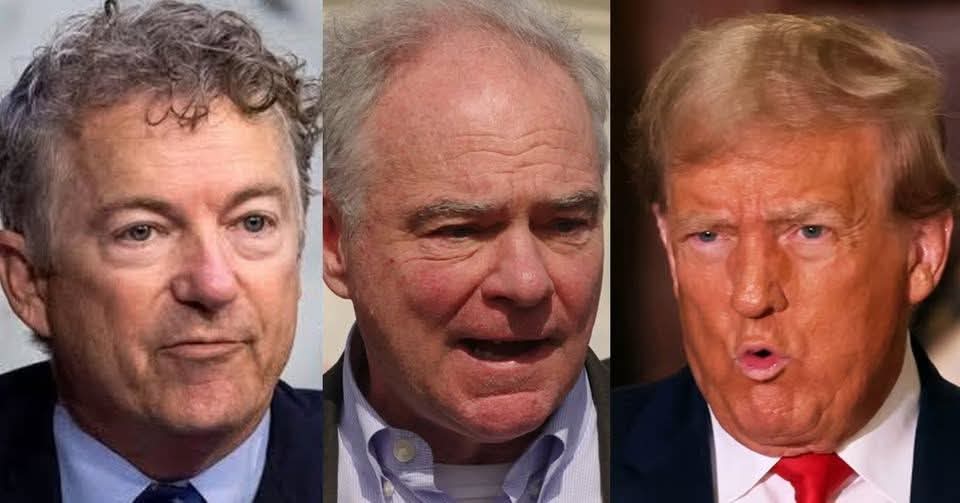
🚨 BREAKING: U.S. Senate Delivers Rare Bipartisan Rebuke — Moves to Curtail Trump’s Military Power After Venezuelan Operation
In a stunning and rare moment of bipartisan pushback, the U.S. Senate advanced a resolution Thursday aimed at restricting President Donald Trump’s ability to order further military action against Venezuela without express congressional approval — marking a significant assertion of legislative authority over foreign policy.
The procedural vote, 52–47, saw a bloc of five Republican senators join all Senate Democrats to advance the measure after a controversial U.S. strike that culminated in the capture of Venezuelan President Nicolás Maduro earlier this mont
🧨 What Sparked the Vote
Earlier this week, U.S. forces conducted a surprise military operation in Caracas, seizing Maduro and transporting him to the United States to face federal charges, including narco-terrorism and drug trafficking. The strike, carried out without advance notice to Congress, immediately sparked fierce debate over presidential war powers and constitutional limits.
The raid, dubbed Operation Absolute Resolve by U.S. military sources, involved extensive bombardments and special operations that left dozens dead and U.S. military personnel wounded — raising alarms among lawmakers who say Trump overstepped his authority. �
🧑⚖️ A Rare Bipartisan Break From Party Lines
While Republican leadership had largely supported Trump’s foreign policy agenda, five GOP senators broke with the president and their party to back the war powers resolution:
Sen. Rand Paul (Ky.)
Sen. Lisa Murkowski (Alaska)
Sen. Susan Collins (Maine)
Sen. Todd Young (Ind.)
Sen. Josh Hawley (Mo.) �
Their defection underscored growing unease about unilateral executive action and concerns that the White House intends further military involvement without proper oversight. �
Sen. Paul stressed that unchecked military authority sets a dangerous precedent, emphasizing that future presidents — regardless of party — must respect constitutional constraints. �
Democratic co-sponsors and other critics argued the vote was a necessary defense of the Constitution, reminding colleagues that only Congress has the power to declare war. �
🧨 Trump Outraged, GOP Rebels Draw Fire
President Trump responded angrily on social media, lambasting the Republican senators who voted with Democrats. Trump said the vote undermines U.S. national security and should disqualify them from future public office. �
His most blistering comments targeted the defecting GOP senators, declaring they “should never be elected to office again” and denouncing the resolution as harmful to American defense.
📜 What the Resolution Does — and Doesn’t
Although the 52–47 tally means the resolution advanced to further consideration, it has several practical hurdles:
It must still clear the Republican-controlled House of Representatives, where its prospects are uncertain. �
If passed by both chambers, it would still face a likely presidential veto. �
Even so, the vote marks a significant symbolic break in GOP support for Trump’s foreign policy and an important assertion of congressional authority under the War Powers Act — a 1973 law designed to limit unilateral presidential military action when Congress has not declared war. �
The resolution would require congressional approval before further U.S. armed forces could be used in hostilities against Venezuela — a sharp rebuke to recent practices in which the administration has failed to provide advance notice or meaningful oversight.
🌎 Broader Implications
Lawmakers on both sides of the aisle warned that the stakes extend far beyond Venezuela. Some Republicans expressed concern that continued unilateral military actions without oversight could entangle the United States in open-ended conflicts in Latin America or elsewhere. �
Foreign policy analysts say the move could signal a growing Congressional insistence on constitutional checks, especially in light of escalating tensions not just in Venezuela but in other regions where Trump has floated military threats. �
If the measure reaches a full vote and passes the Senate and House, it could reignite a broader war powers debate that has simmered for decades — raising questions about the balance between presidential authority and legislative oversight in U.S. foreign policy.
For now, Thursday’s vote stands as a striking moment of bipartisan pushback and a reminder that even in a deeply polarized environment, lawmakers can still unite to challenge executive overreach.

BREAKING: Study reveals Trump’s Iran war has cost American households $750 each Trump launched a war in Iran in February without a single vote from Congress, and American families are now footing the bill. A new analysis from Moody’s Analytics puts the total cost to U.S. households at $100 billion so far, working out to roughly $750 per household.
BREAKING: TOTAL DEFEAT! Trump abandons his $1.8 billion slush fund for insurrectionists and MAGA pedophiles after America revolted against the deeply corrupt plan.
BREAKING: A federal appeals court dealt a major blow to the Trump administration’s transgender military policy, ruling that thousands of transgender service members are likely to succeed in their constitutional challenge.
Kennedy Center Fight Sparks Fresh Trump Reactions Political attention remains fixed on Donald J. Trump after a federal judge ordered the removal of Trump’s name from the Kennedy Center and blocked plans to close the institution for major renovations.
🚨👀 THE EPSTEIN FILE SHOWDOWN IS LITERALLY BLOWING UP WASHINGTON! Congressman Thomas Massie has completely rocked the political world by demanding the immediate release of the unredacted Jeffrey Epstein files! Massie went absolutely wild on the DOJ, accusing them of actively shielding insanely powerful names from the public view. Transparency advocates are screaming that the full truth must drop to restore public trust, while critics claim it’s a dangerous media circus. Is a massive cover-up happening right now, or is this just political theater? Do you support a full congressional review to uncover the truth, or it will raise a political warfare?

TUSK CZY NAWROCKI? Nowy sondaż szokuje. Polacy wyraźnie wybrali, komu ufają bardziej
At 8:15 this morning, the President of the United States began panicking in front of the entire world. For more than seven hours, he posted nearly 50 times. And when he finally slowed down, it would stand as one of the most revealing fits of rage of his presidency to date. Because what he shared was beyond any reasonable person’s comprehension.
🚨 JUST IN: 🇺🇸 US forces fire a missile at a ship attempting to bypass the American blockade in the Gulf of Oman
Donald J Trump’s name being torn down from the John F. Kennedy Center for the Performing Arts in Washington, D.C. wasn’t just a slap in the face to the GOP and their bad policies it was a reminder that hate has no place in America. U.S.A.
🚨 JUST IN: 🇵🇱🇷🇺 Polish Foreign Minister Radosław Sikorski says: “Regardless of whether it was on purpose or the result of ineptitude, Russia is still dangerous and we must defend ourselves against it.”
🚨 JUST IN: 🇮🇷🇺🇸 An Iranian missile strike on a U.S. military base in Kuwait reportedly injured five Americans and damaged MQ-9 Reaper
