
NEWS
BREAKING: Local officials declare they have authority to prosecute ICE agent Jonathan Ross – Renee Good’s killer. And they will.

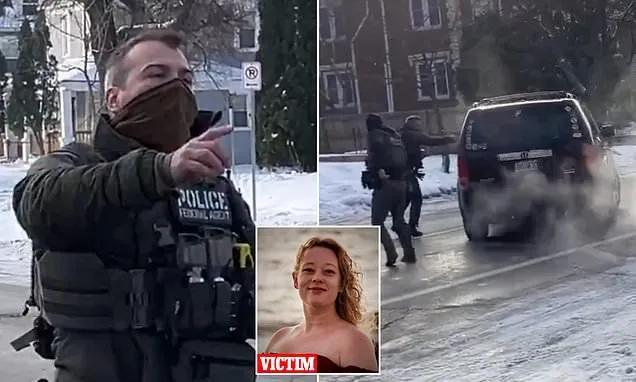
BREAKING: Local Officials Say They Have Authority to Prosecute ICE Agent Jonathan Ross — The Killing of Renee Good Sparks Constitutional Battle
A fatal shooting by a U.S. Immigration and Customs Enforcement (ICE) officer has ignited a high-stakes legal and political confrontation between Minnesota officials and federal authorities — with local prosecutors now asserting they do have authority to pursue criminal charges against the agent involved, despite federal claims of immunity.
The incident occurred on January 7, 2026, when ICE agent Jonathan Ross shot and killed 37-year-old Renee Nicole Good, a U.S. citizen, during a federal operation in south Minneapolis. Good was inside her vehicle when Ross opened fire; she was later pronounced dead at a hospital. Her killing instantly sparked outrage, protests, and demands for accountability from community leaders and civil rights groups. �
Who Was Involved — The Officer and the Victim
According to court records and federal law enforcement sources, the agent identified as responsible for the shooting is Jonathan Ross, a long-time federal enforcement officer who previously served in the U.S. Border Patrol and ICE’s special response units. His record includes service in Iraq as part of the National Guard and years of law enforcement experience, including a prior incident in mid-2025 where he was seriously injured after being dragged by a fleeing suspect’s vehicle during an enforcement action. �
Renee Good, a mother of three and local community member, was fatally shot when agents confronted her vehicle during the operation. Video widely circulated on social media showed the moments before and after the shooting, prompting conflicting narratives between federal authorities claiming self-defense and local witnesses disputing that account. �
The Federal Stance: Immunity and Internal Investigation
Federal officials, including Department of Homeland Security Secretary Kristi Noem and Vice President J.D. Vance, have defended the agent’s actions, asserting that Ross acted according to his training and in response to imminent danger. The Trump administration has signaled that federal law grants broad protection to officers acting within the scope of their duties, arguing that the shooting was justified. �
The FBI has taken over the investigation, subsequently barring Minnesota state investigators from accessing key evidence, including body camera footage and other materials — a move that has deepened concerns among local officials about transparency and fairness in the inquiry. �
State and Local Pushback: Jurisdiction and Prosecution
In sharp contrast, Minnesota officials — including Hennepin County Attorney Mary Moriarty and Governor Tim Walz — have publicly asserted that the state does have jurisdiction to investigate and prosecute alleged crimes even if committed by a federal officer.
Moriarty, whose office is responsible for prosecuting violent crimes in the Minneapolis area, has formally called on the public to submit video and other evidence directly to her office so her prosecutors can evaluate whether criminal charges should be filed. She emphasized that state law does not automatically strip local authority just because the suspect is a federal agent. �
At a press conference, Moriarty stated that her office “does have jurisdiction to make this decision with what happened in this case” and that it “does not matter that it was a federal law enforcement agent,” directly challenging the Trump administration’s position. �
https://www.kyoutv.com
Governor Walz has also criticized the federal handling of the case, calling for Minnesota law enforcement to be allowed a meaningful role in the probe and warning that excluding the state could erode public trust
Legal Experts: Constitutional Clash over Supremacy and Immunity
Legal scholars note that the dispute hinges on constitutional doctrine, particularly the Supremacy Clause, which generally shields federal officers from state prosecution when acting within their lawful authority. But experts argue that immunity is not absolute — if an agent’s actions are found unlawful or unreasonable under state law, prosecution might still be possible. �
A law professor interviewed by Newsweek said there appears to be “more than enough evidence to support prosecution and to allow a jury to evaluate criminal liability” depending on how state prosecutors view the situation and what evidence is available. �
However, the exclusion of state investigators from the federal evidence has complicated the process. Without access to critical raw material, state prosecutors may struggle to build a case — a reality acknowledged by Minnesota law enforcement officials. �
WDRB
Public Reaction and Broader Impact
The shooting has ignited more than legal arguments — it has fueled protests in Minneapolis and drawn national attention to the broader issue of federal enforcement authority and police accountability. Some local leaders have explicitly criticized federal narratives about the shooting and called for ICE to be removed from operations in Minneapolis entirely. �
With tensions running high, the case is shaping into a flashpoint in the ongoing national debate over federal law enforcement powers, state sovereignty, and how justice is administered for actions taken during federal operations.

BREAKING: Study reveals Trump’s Iran war has cost American households $750 each Trump launched a war in Iran in February without a single vote from Congress, and American families are now footing the bill. A new analysis from Moody’s Analytics puts the total cost to U.S. households at $100 billion so far, working out to roughly $750 per household.
BREAKING: TOTAL DEFEAT! Trump abandons his $1.8 billion slush fund for insurrectionists and MAGA pedophiles after America revolted against the deeply corrupt plan.
BREAKING: A federal appeals court dealt a major blow to the Trump administration’s transgender military policy, ruling that thousands of transgender service members are likely to succeed in their constitutional challenge.
Kennedy Center Fight Sparks Fresh Trump Reactions Political attention remains fixed on Donald J. Trump after a federal judge ordered the removal of Trump’s name from the Kennedy Center and blocked plans to close the institution for major renovations.
🚨👀 THE EPSTEIN FILE SHOWDOWN IS LITERALLY BLOWING UP WASHINGTON! Congressman Thomas Massie has completely rocked the political world by demanding the immediate release of the unredacted Jeffrey Epstein files! Massie went absolutely wild on the DOJ, accusing them of actively shielding insanely powerful names from the public view. Transparency advocates are screaming that the full truth must drop to restore public trust, while critics claim it’s a dangerous media circus. Is a massive cover-up happening right now, or is this just political theater? Do you support a full congressional review to uncover the truth, or it will raise a political warfare?

TUSK CZY NAWROCKI? Nowy sondaż szokuje. Polacy wyraźnie wybrali, komu ufają bardziej
At 8:15 this morning, the President of the United States began panicking in front of the entire world. For more than seven hours, he posted nearly 50 times. And when he finally slowed down, it would stand as one of the most revealing fits of rage of his presidency to date. Because what he shared was beyond any reasonable person’s comprehension.
🚨 JUST IN: 🇺🇸 US forces fire a missile at a ship attempting to bypass the American blockade in the Gulf of Oman
Donald J Trump’s name being torn down from the John F. Kennedy Center for the Performing Arts in Washington, D.C. wasn’t just a slap in the face to the GOP and their bad policies it was a reminder that hate has no place in America. U.S.A.
🚨 JUST IN: 🇵🇱🇷🇺 Polish Foreign Minister Radosław Sikorski says: “Regardless of whether it was on purpose or the result of ineptitude, Russia is still dangerous and we must defend ourselves against it.”
🚨 JUST IN: 🇮🇷🇺🇸 An Iranian missile strike on a U.S. military base in Kuwait reportedly injured five Americans and damaged MQ-9 Reaper
