
NEWS
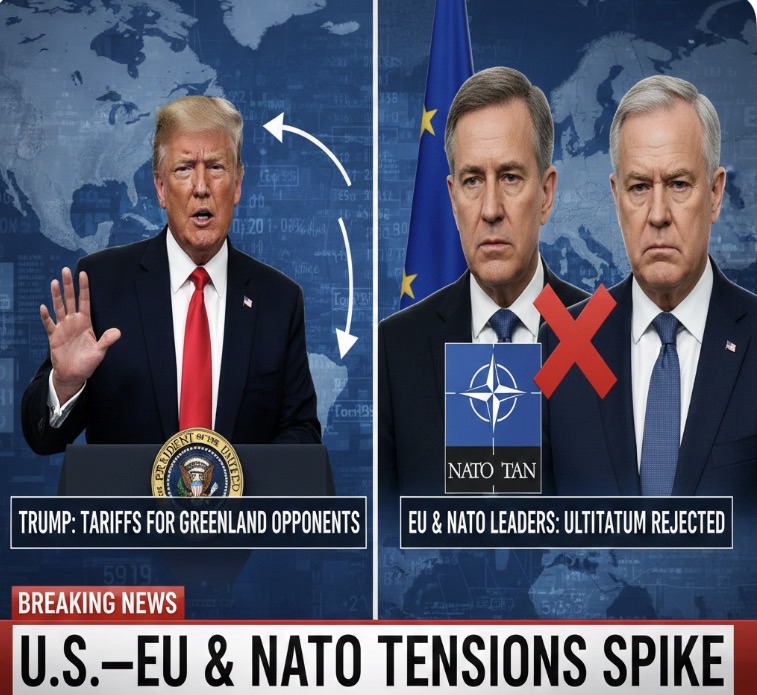
FLASH; U.S.–EU And NATO Tensions Spike as Donald Trump Floats Tariffs for Opposing Greenland Plans as The President Issues Ultimatum to Opposing Countries

U.S.–EU and NATO Tensions Spike as Donald Trump Floats Tariffs for Opposing Greenland Plans
Washington, D.C., January 18, 2026 — Tensions between the United States, the European Union, and NATO allies reached a new high this week after President Donald Trump signaled plans to impose tariffs on European countries that oppose his administration’s controversial Greenland policy. The announcement has sparked alarm across the Atlantic, raising fears of a broader geopolitical rift within long-standing alliances.
In a statement released from the White House, Trump issued a sharp ultimatum: countries that continue to resist U.S. plans regarding Greenland could face “significant economic consequences,” including targeted tariffs on key goods and services. While the President did not specify which sectors would be hit, sources indicate that technology, energy, and defense-related exports are likely targets.
“This is about protecting American interests,” Trump said. “If countries think they can oppose our plans without consequences, they’re sorely mistaken. The United States will not back down.”
European leaders reacted quickly, expressing outrage and frustration. The European Union’s Commission issued a statement warning that any U.S. tariffs would undermine trade relations and could prompt retaliatory measures, including visa restrictions and exclusion from the European Travel Information and Authorization System (ETIAS). Some EU officials described Trump’s threats as “unprecedented and destabilizing,” emphasizing that Greenland is not a unilateral matter for the United States to decide.
NATO, too, expressed concern. Senior officials noted that imposing tariffs on allied nations could strain the military and strategic cohesion of the alliance, particularly at a time when collective security depends on cooperation amid growing global threats. A NATO spokesperson stated, “We urge all member states to pursue dialogue rather than coercion. Alliances are built on trust, not ultimatums.”
Trump’s Greenland plan has been a recurring point of contention. The President has repeatedly emphasized the strategic importance of the Arctic region, citing defense installations, natural resources, and U.S. geopolitical interests. Critics argue, however, that Trump’s approach risks alienating key allies and could disrupt long-established transatlantic economic and military partnerships.
Analysts suggest that the tariffs could escalate into a broader trade war between the United States and European nations. Some predict that retaliatory measures could include restrictions on U.S. business operations in Europe, heightened regulatory scrutiny, and limits on American citizens’ access to European markets and services.
Despite the backlash, the White House signaled that the administration is prepared to follow through on its threats. Economic advisors reportedly believe that the potential gains from Greenland-related policies outweigh the risks of alienating EU partners, setting the stage for a tense standoff that could define U.S.–European relations in 2026.
As the situation develops, both sides face mounting pressure to avoid further escalation. European leaders are reportedly preparing a coordinated response, while U.S. officials are emphasizing Trump’s insistence that American interests come first. The coming weeks may prove decisive in determining whether diplomacy or economic confrontation will dominate the transatlantic relationship.

BREAKING: Study reveals Trump’s Iran war has cost American households $750 each Trump launched a war in Iran in February without a single vote from Congress, and American families are now footing the bill. A new analysis from Moody’s Analytics puts the total cost to U.S. households at $100 billion so far, working out to roughly $750 per household.
BREAKING: TOTAL DEFEAT! Trump abandons his $1.8 billion slush fund for insurrectionists and MAGA pedophiles after America revolted against the deeply corrupt plan.
BREAKING: A federal appeals court dealt a major blow to the Trump administration’s transgender military policy, ruling that thousands of transgender service members are likely to succeed in their constitutional challenge.
Kennedy Center Fight Sparks Fresh Trump Reactions Political attention remains fixed on Donald J. Trump after a federal judge ordered the removal of Trump’s name from the Kennedy Center and blocked plans to close the institution for major renovations.
🚨👀 THE EPSTEIN FILE SHOWDOWN IS LITERALLY BLOWING UP WASHINGTON! Congressman Thomas Massie has completely rocked the political world by demanding the immediate release of the unredacted Jeffrey Epstein files! Massie went absolutely wild on the DOJ, accusing them of actively shielding insanely powerful names from the public view. Transparency advocates are screaming that the full truth must drop to restore public trust, while critics claim it’s a dangerous media circus. Is a massive cover-up happening right now, or is this just political theater? Do you support a full congressional review to uncover the truth, or it will raise a political warfare?

TUSK CZY NAWROCKI? Nowy sondaż szokuje. Polacy wyraźnie wybrali, komu ufają bardziej
At 8:15 this morning, the President of the United States began panicking in front of the entire world. For more than seven hours, he posted nearly 50 times. And when he finally slowed down, it would stand as one of the most revealing fits of rage of his presidency to date. Because what he shared was beyond any reasonable person’s comprehension.
🚨 JUST IN: 🇺🇸 US forces fire a missile at a ship attempting to bypass the American blockade in the Gulf of Oman
Donald J Trump’s name being torn down from the John F. Kennedy Center for the Performing Arts in Washington, D.C. wasn’t just a slap in the face to the GOP and their bad policies it was a reminder that hate has no place in America. U.S.A.
🚨 JUST IN: 🇵🇱🇷🇺 Polish Foreign Minister Radosław Sikorski says: “Regardless of whether it was on purpose or the result of ineptitude, Russia is still dangerous and we must defend ourselves against it.”
🚨 JUST IN: 🇮🇷🇺🇸 An Iranian missile strike on a U.S. military base in Kuwait reportedly injured five Americans and damaged MQ-9 Reaper
